Content Creation
In the contemporary digital landscape, content creation has evolved far beyond simply pressing the ‘record’ button. It is now a sophisticated discipline that merges narrative psychology, rigorous technical engineering, and artistic vision. Whether you are producing a corporate documentary for a FTSE 100 company or a dynamic commercial for a startup, the difference between an amateur clip and a professional production often lies in the invisible details of the workflow.
From the initial storyboard pitch to the final codec compression for streaming, every decision impacts the viewer’s engagement and the project’s return on investment. This resource explores the critical pillars of professional video content creation, offering a roadmap to navigate the complexities of modern production pipelines in the UK market and beyond.
The Strategic Value of Pre-Production and Storyboarding
Many creators underestimate pre-production, viewing it as a bureaucratic hurdle rather than a creative safety net. However, industry data suggests that a lack of preparation is the primary cause of budget overruns. Skipping professional storyboarding, for instance, can lead to significant financial losses—estimated at upwards of £2,000 per shooting day due to wasted time and lack of direction on set.
Securing Funding and Client Buy-In
Before a single frame is shot, the vision must be sold. In competitive markets like London, agencies and stakeholders require more than just a script; they need visual confirmation of the investment. A well-crafted storyboard or animatic serves as a contract of expectations. It bridges the gap between a director’s imagination and a client’s business objectives, significantly reducing the communication errors that can ruin nearly half of all client validations later in the process.
From Script to Shot List
Breaking down a script into a coherent shot list is an exercise in narrative logic. It is not merely about listing angles, but about ensuring the narrative flow remains intact. Determining whether a hand-drawn approach or a digital storyboard best suits a specific budget (e.g., a £10k commercial versus a micro-budget short) is a crucial early decision that dictates the production’s agility.
Cinematography: Sensors, Lenses, and Visual Language
The debate between gear and technique is eternal, but understanding the physics of your equipment is non-negotiable for high-end content creation. The choice of sensor size and glass defines the texture of your story.
Full Frame vs. Super 35
There is a pervasive myth that Full Frame sensors are always superior. While they offer a distinct aesthetic, they are not always the best choice for documentary work or fast-paced narratives. Large sensors make maintaining focus significantly harder during movement and can introduce readout issues (rolling shutter) that warp handheld footage. Often, the Super 35 look feels more naturally ‘cinematic’ for narrative fiction because it aligns with the classic field of view that audiences have associated with cinema for decades.
The Role of Optics and Lighting
Your choice of lens conveys subconscious messages to the viewer. Vintage glass is often sought after to convey ‘authenticity’ and warmth, contrasting with the clinical sharpness of modern lenses. Similarly, lighting creates the genre context: flat lighting often signals comedy or corporate clarity, while deep shadows communicate drama and tension. Understanding how to create a mood board that accurately communicates these vibes to a Director of Photography is a skill that separates effective producers from the rest.
Movement as a Narrative Tool
Camera movement should never be arbitrary. Techniques like the ‘Vertigo Effect’ create instant unease, while a parallax slide can make small locations appear more expansive. However, constant motion can be a mistake, potentially causing motion sickness in viewers. Knowing when to use a tripod for stability—essential for testimonials—versus a gimbal or drone for cinematic reveals is a hallmark of mature direction.
Optimising the Post-Production Pipeline
Post-production is where the story is rewritten, but without a robust pipeline, it is also where billable hours evaporate. A disorganized folder structure can cost an editor up to 15% of their time simply searching for assets.
Workflow and Collaboration
In an era where remote collaboration is standard, managing assets is critical. Naming convention mistakes, leading to the infamous ‘Final_Final_v3’ confusion, are unprofessional and risky. Implementing systems like cloud locking prevents editors from overwriting each other’s work. Furthermore, deciding between a local render farm or cloud rendering for one-off projects is a financial calculation that every post-production supervisor must make to avoid bottlenecks.
The Art of the Edit
Editing is rhythmic. Cutting a showreel that gets hired by top agencies requires brevity; a punchy 60-second reel is almost always more effective than a dragging 3-minute compilation. The interplay between audio and visual is equally vital—editing to music requires letting the visuals breathe without being dominated by the track. Knowing when to ‘lock’ the edit before sending it to sound design and colour grading is essential to prevent costly revisions.
Technical Delivery and Distribution Strategy
A masterpiece is useless if it cannot be viewed smoothly. The final stage of content creation is ensuring the technical delivery matches the consumption habits of the audience.
Resolution and Reality
The push for 4K is strong, but is it always necessary? While 4K is visible on a television, it is often indistinguishable from HD on a 6-inch mobile screen. Moreover, high bitrates can hurt SEO and user experience by increasing page load times and causing buffering on mobile data plans. Understanding how to downscale 4K to 1080p can actually result in sharper HD imagery than shooting natively in HD, offering a ‘future-proof’ archive while delivering a mobile-optimised file.
Codecs and Streaming
For B2B content creators, the choice of platform matters. Using Vimeo Enterprise or custom HTML5 players allows for gated video content that captures high-quality leads, unlike open platforms. Technical knowledge of adaptive bitrate streaming is vital for internal corporate portals to ensure playback stability across various bandwidths. Finally, avoiding aspect ratio mistakes ensures that text and graphics remain visible on vertical mobile feeds, which is currently where a vast majority of UK consumers engage with video content.

4K vs. 1080p for Mobile: A Data-Backed Guide for UK Content Strategists
For mobile content, the critical decision isn’t a simple choice between 4K and 1080p, but a strategic calculation of perceptual return on investment (ROI). Prioritising High Dynamic Range (HDR) and creating a superior, sharper 1080p file from a 4K master…
Lire la suite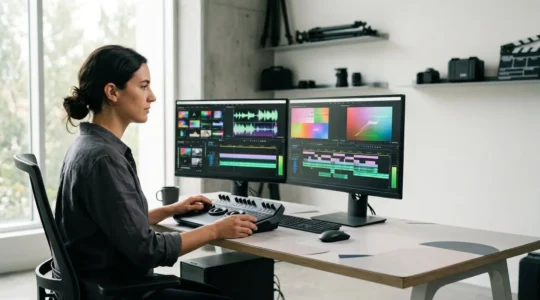
How to Cut a Showreel That Gets You Hired by Top UK Agencies?
Your showreel is a 60-second audition to avoid the « no » pile, and most are failing because they try to impress instead of proving competence. Brevity is non-negotiable; anything over 60-90 seconds signals a disrespect for a recruiter’s time and an…
Lire la suite
Corporate Clean or Gritty Doc-Style: Which Aesthetic Fits Your Brand Story?
The visual style of your video isn’t decoration; it’s a core part of your brand’s messaging, capable of building or breaking trust in seconds. Lighting, lens choice, and color are not just technical details—they are the vocabulary of a « visual…
Lire la suite
How to Use Camera Movement to Reveal Information Without Dialogue?
Camera movement is your silent script; its true power lies in the psychological subtext it creates, not just the physical motion itself. Intentional moves like the Vertigo effect or parallax slides manipulate the viewer’s sense of space and emotion to…
Lire la suite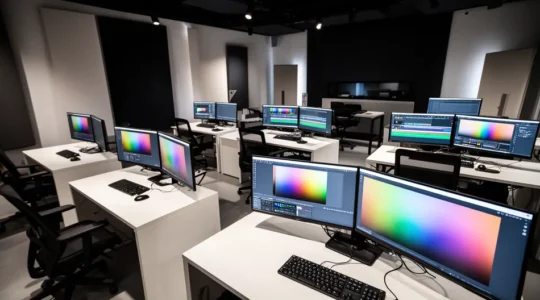
How to Design a Post-Production Pipeline That Prevents Bottlenecks?
Bottlenecks are not random events; they are symptoms of a flawed production architecture that actively costs you money and time. Architecting folder structures and naming conventions directly impacts billable efficiency by reducing search time. Strategic decisions on cloud rendering, file…
Lire la suite
Why Full-Frame Sensors Are Not Always the Best Choice for Documentary Work?
Contrary to the hype, a full-frame sensor’s shallow depth of field is often a liability, not a benefit, in the unpredictable world of documentary filmmaking. The relentless pursuit of « bokeh » sacrifices critical focus, rendering potentially powerful moments unusable in the…
Lire la suite
How to Encode Video for Streaming to Avoid Buffering on Mobile Data?
Eliminating mobile video buffering isn’t about finding one perfect bitrate; it’s about implementing a flexible, multi-layered Adaptive Bitrate (ABR) system. A static, high-bitrate video file penalizes users on weak connections, hurting SEO and user experience. An ABR system dynamically serves…
Lire la suite
How to Pitch Storyboards That Secure Funding from London Agencies?
Securing funding from a London agency isn’t about selling a creative vision; it’s about presenting a de-risked financial instrument. Your storyboard’s primary function is to prove commercial viability and mitigate investment risk, not just illustrate shots. Strategic communication, including the…
Lire la suite