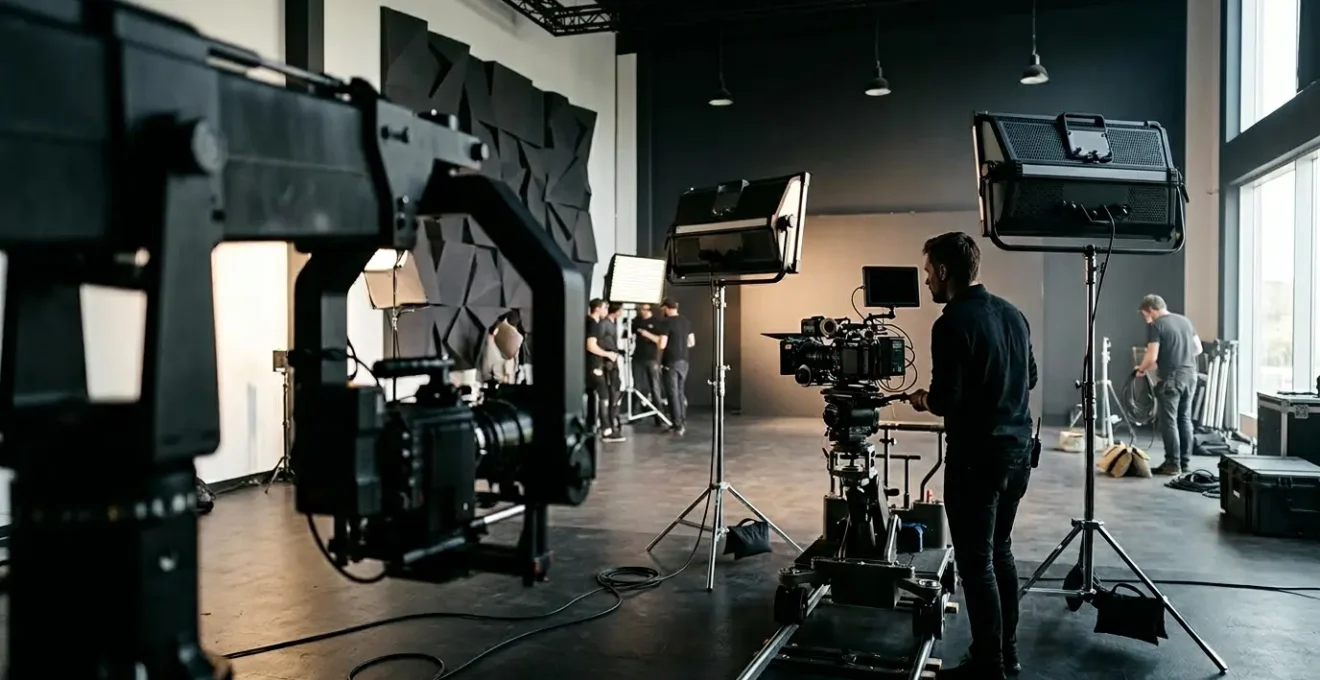
A professionally produced £5,000 video is not an expense; it’s a low-risk financial asset engineered to deliver a predictable return, while « cheap » content is a high-risk gamble with significant hidden costs.
- High-quality production directly mitigates business risks like audience distrust, operational disruption, and severe legal penalties.
- Every element, from audio quality to launch timing, is a calculated variable designed to maximize viewer retention and conversion.
Recommendation: Stop evaluating video on cost alone and start assessing it as a strategic investment based on its potential to reduce CPA and generate qualified leads.
As a business owner, seeing a £5,000 invoice for a single brand video can feel daunting. The immediate thought is often, « Couldn’t I get this done for a fraction of the cost? » It’s a valid question. The market is flooded with offers for cheap video content, and the common wisdom suggests that any video is better than no video. Many believe the key is simply to « look professional » or « tell a good story, » assuming these are achievable on a minimal budget. This perspective, however, overlooks the most critical factor for any SME: financial risk.
The real difference between a £500 video and a £5,000 video isn’t just polish; it’s a fundamental shift in approach. The cheaper option is a creative expense, a lottery ticket you hope will pay off. The premium option is a calculated business investment, an asset engineered from the ground up to mitigate risk and generate a measurable return. The « quality » you’re paying for isn’t just aesthetic—it’s a series of strategic decisions that directly protect your brand, your operations, and your bottom line.
But what if the true cost of « cheap » video isn’t the initial invoice, but the hidden liabilities it creates? The real conversation isn’t about spending more; it’s about investing wisely to avoid the catastrophic financial pitfalls of cutting the wrong corners. This is where the 300% ROI difference originates: not from fancy cameras, but from a process built on financial foresight.
This article will deconstruct the £5,000 video, moving beyond surface-level discussions of quality. We will analyse how specific, high-value components—from the science of audio trust to the legal minefield of copyright—function as ROI-driving mechanisms. By understanding these elements, you can see precisely how a strategic investment in video becomes one of the most powerful financial levers in your marketing arsenal.
Summary: The Financial Anatomy of a High-ROI Brand Video
- Why Low-Quality Audio Instantly Destroys Trust with British Consumers?
- How to Manage a Corporate Video Shoot in London Without Disrupting Operations?
- Freelancer vs Production Agency: Which is Safer for a Product Launch?
- The Copyright Trap That Could Cost Your Company £20,000 in Fines
- When to Release Your Campaign Video: Timing Your Launch for Maximum Impact
- Why Do 60% of Viewers Abandon Your Sales Video Before the Call to Action?
- User Generated Content or High-Gloss Ad: Which Lowers CPA?
- How to Use Gated Video Content to Capture High-Quality B2B Leads?
Why Low-Quality Audio Instantly Destroys Trust with British Consumers?
The first casualty of a low-budget video is almost always the audio. While a grainy image might be forgiven, poor sound—whether it’s muffled, echoing, or competing with background noise—triggers an immediate, subconscious rejection from the viewer. This isn’t a matter of preference; it’s a principle of cognitive psychology. Our brains are wired for efficiency, a concept known as « cognitive fluency. » When information is easy to process, we are more likely to trust it and the person delivering it. Bad audio makes the brain work harder, creating a feeling of unease and inherent distrust.
This is not just theory. Groundbreaking research from cognitive psychology demonstrates that processing difficulty directly reduces credibility. A study by USC and the Australian National University confirmed that audio quality profoundly influences whether people believe what they hear. When you make it difficult for an audience to process your message, you are effectively telling their brain that your brand is not credible. This happens in the first few seconds, long before they’ve even considered your product.

Therefore, investing in professional audio is not about a « premium feel »; it’s a direct investment in your brand’s trustworthiness. A sound engineer who knows how to capture crisp, clean dialogue is eliminating the primary source of subconscious friction between you and your customer. That clarity translates directly into higher perceived value and a greater willingness to engage with your call to action. The cost of a good microphone and an experienced operator is minimal compared to the cost of losing 60% of your audience’s trust before you’ve even made your pitch.
How to Manage a Corporate Video Shoot in London Without Disrupting Operations?
One of the largest hidden costs of a « cheap » video shoot is operational disruption. An unmanaged freelancer or an inexperienced crew can bring your business to a standstill, costing you thousands in lost productivity and sales. The SME owner, focused on the production invoice, often fails to calculate the opportunity cost of having their sales team offline for a day or their main office in chaos. A professional agency, however, prices this risk mitigation directly into their process.
They operate with what can be described as a « surgical strike » methodology. This involves meticulous pre-production and planning to ensure the shoot has the smallest possible footprint on your daily operations. This isn’t an accident; it’s a core competency. They conduct location reconnaissance, map power needs to avoid tripping circuits, schedule filming around critical business hours, and coordinate with facilities to manage noise. This process transforms a potentially chaotic event into a controlled, efficient one.
The financial impact of this planning is significant. An unplanned shoot can easily disrupt 10-15 staff members for a full day, leading to productivity losses that can exceed the entire cost of the video itself. A well-managed shoot might only require minimal involvement from 3-5 key people for a couple of hours. This difference is not a « nice-to-have »; it’s a hard financial calculation. As data from production cost analysis shows, managed disruption can be a fraction of the cost of a full-day office blockout.
Your Action Plan: The Minimal Disruption Location Checklist
- Map Power Needs: Identify dedicated 20-amp circuits to avoid overloading systems and causing a shutdown.
- Schedule Strategically: Block shoot times around key business activities, avoiding Monday morning meetings or Friday deadlines.
- Plan Equipment Layout: Pre-plan where cameras, lights, and cables will go to maintain clear foot traffic corridors for staff.
- Identify Quiet Zones: Scout sound-isolated areas for interviews to avoid disrupting sales calls or important meetings.
- Coordinate with Facilities: Arrange for HVAC systems to be temporarily quieted during audio recording to ensure clean sound without impacting the entire building.
When you pay for a £5,000 video, you are not just buying a final product. You are investing in a process designed to protect your company’s most valuable asset: its time. The fee includes the expertise to execute a complex logistical operation within a live business environment without crippling its ability to generate revenue.
Freelancer vs Production Agency: Which is Safer for a Product Launch?
For a critical event like a product launch, the choice between a solo freelancer and a production agency isn’t about cost—it’s about risk management. A freelancer might quote £1,500, while an agency quotes £5,000. The £3,500 difference isn’t just margin; it’s the price of certainty. A solo freelancer represents a single point of failure. If their camera breaks, their hard drive corrupts, or they fall ill, your entire launch is jeopardized. There is no backup.
A production agency, by contrast, is a system of redundancies. They have multiple camera bodies, backup data protocols, and a team of specialists. If the lead cinematographer is sick, another steps in. This built-in contingency plan is non-negotiable for a time-sensitive, high-stakes project. Furthermore, agencies carry comprehensive insurance. A reputable UK agency will have £1-5 million in public liability insurance as standard, protecting your business from any on-set accidents. Many freelancers operate with minimal or no insurance, shifting that liability entirely onto you.
This table illustrates the stark difference in risk profiles. When you’re launching a product, you are paying the agency to absorb these risks.
| Risk Factor | Solo Freelancer | Production Agency |
|---|---|---|
| Equipment Failure Backup | None/Limited | Multiple camera bodies, lenses, lights |
| Personnel Redundancy | Single point of failure | Team of 3-8 specialists |
| Insurance Coverage | Often minimal/none | £1-5M public liability standard |
| Data Backup Protocol | Personal system | Triple redundancy standard |
| Deliverables Package | Single video file | Full campaign assets (15+ variations) |

Finally, an agency delivers more than a single video file. They provide a full package of campaign assets: social media cutdowns, vertical versions, and different hooks. This multiplies the value of your investment, giving you a suite of tools to deploy across your entire funnel. The freelancer’s single video is a one-shot attempt; the agency’s package is a complete campaign-in-a-box. For a product launch, the « expensive » agency is unequivocally the safer, higher-ROI choice.
The Copyright Trap That Could Cost Your Company £20,000 in Fines
One of the most dangerous and overlooked aspects of cheap video production is copyright and usage rights. A low-cost producer often uses royalty-free music or stock footage without scrutinizing the license, or fails to secure proper buyouts from talent. This plants a legal time bomb in your marketing that can detonate years later, with devastating financial consequences. A £20,000 fine for infringement isn’t a scare tactic; it’s a realistic outcome for a company that gets this wrong.
The trap has many forms. A « royalty-free » music track might not be licensed for paid advertising. A background poster or even a piece of designer furniture visible in the shot can constitute « incidental copyright infringement. » The most common pitfall, however, is talent usage. An actor or model paid a day rate for a shoot does not automatically grant you the right to use their image in perpetuity across all media. If the contract is not explicit, they can come back years later and claim substantial fees for unauthorized use. As one industry expert notes, this is a frequent and costly mistake.
A £500 day rate talent fee doesn’t automatically grant perpetual usage rights – proper agency contracts stipulate buyouts preventing future legal claims.
– Industry Legal Expert, Video Production Best Practices Guide
A professional agency mitigates this risk entirely. A significant portion of their fee is dedicated to rights management. They work with legal counsel to draft iron-clad contracts, negotiate comprehensive buyouts with talent, and use rights-managed music and footage with licenses that are specifically cleared for your intended use (e.g., paid social ads, broadcast, etc.). They provide a complete chain of title for every asset in your video, indemnifying you against future claims.
This legal protection is not an « add-on »; it is a core component of the value proposition. The £5,000 price tag includes a robust legal shield that transforms your video from a potential liability into a secure asset. The peace of mind from knowing you won’t face a crippling lawsuit down the line is, by itself, worth the investment.
When to Release Your Campaign Video: Timing Your Launch for Maximum Impact
Creating a high-quality video asset is only half the battle. The other half is ensuring it gets seen by the right people at the right time. A £5,000 video deserves more than a « post and pray » launch strategy. A key differentiator of a professional production is that the strategy extends beyond the final render, incorporating a plan for maximizing initial velocity and engagement. This starts with data-driven timing.
For a B2B audience, for example, timing is everything. Releasing a video on a Friday afternoon is marketing malpractice, as engagement plummets heading into the weekend. In contrast, platform analytics reveal that B2B YouTube videos posted on Tuesday mornings can see up to 40% higher engagement. A strategic partner understands these nuances and builds the entire launch calendar around these optimal windows to ensure your investment has the best possible chance of success from the first second it goes live.
Moreover, the launch isn’t a single event but a coordinated sequence. A high-impact launch builds anticipation and momentum before the video is even released. This « content surround » strategy ensures that when the video does drop, there is already a warmed-up audience waiting to watch, comment, and share. A typical pre-launch sequence might look like this:
- Day -7: Release high-quality behind-the-scenes photos on Instagram to create initial buzz.
- Day -5: Share quotes from team members about the project on LinkedIn, humanizing the brand.
- Day -3: Post a countdown timer with a compelling thumbnail preview on all social channels.
- Day -1: Send an exclusive « premiere tomorrow » message to your email subscriber list.
- Day 0: Launch the video simultaneously across all platforms at the pre-determined optimal time.
- Day +1 & +3: Share key moments as short social clips and publish a blog post with the video embed to extend its life.
This strategic rollout is included in the cost of a premium video. You are not just paying for the asset, but for the expertise to launch it effectively. This turns your video from a passive piece of content into the centerpiece of an active, engaging, and ultimately more profitable campaign.
Why Do 60% of Viewers Abandon Your Sales Video Before the Call to Action?
The single most important metric for video ROI is viewer retention. If a viewer doesn’t reach your call to action (CTA), the video has a 0% conversion rate for that person, no matter how beautiful it looks. A common failure of cheap videos is that they are boring. They follow a predictable, linear path that fails to hold the viewer’s dwindling attention. The data shows that most viewers abandon a video within the first 10-15 seconds. So how do you keep them hooked?
The answer lies in a technique called the « pattern interrupt. » This involves deliberately breaking the viewer’s expectation with a sudden change in visual style, sound, camera angle, or on-screen graphics. These interrupts act as a mental reset, pulling the viewer’s attention back to the screen. They can be as simple as a quick text overlay, a sound effect, or a jump cut. The key is their frequency. According to Wistia data, videos that incorporate pattern interrupts every 7-10 seconds maintain a watch time that is 2.6 times longer than those that don’t. This is a massive, measurable lift in engagement.
A professional editor understands how to weave these interrupts into the narrative seamlessly. This is a science, not an art. It involves A/B testing different hooks, analyzing audience retention graphs, and optimizing the edit based on what the data says. A powerful example is the success of the brand Shapermint.
Case Study: Shapermint’s Creative Testing and ROI
Shapermint ran extensive experiments on YouTube over seven weeks to discover which creative combinations drove the best results. By systematically testing different video hooks, including user testimonials, product demos, and special offers—each with unique pacing and messaging—they were able to identify the most effective patterns. The result of this data-driven approach was a 21% reduction in cost per acquisition (CPA) and a 50% increase in total purchases.
This is what you pay for in a £5,000 video: an editor who is also a data analyst, obsessed with keeping eyeballs on the screen until the moment you ask for the sale. They are not just making a video; they are engineering an attention-holding machine designed to maximize the number of viewers who see your CTA.
User Generated Content or High-Gloss Ad: Which Lowers CPA?
The debate between authentic, low-fi User Generated Content (UGC) and a high-gloss, professionally produced ad often misses the point. It’s not an « either/or » question. The strategic question is « when and where? » A sophisticated marketing strategy uses both, deploying them at different stages of the sales funnel to achieve specific financial objectives, primarily lowering the overall Cost Per Acquisition (CPA).
UGC is incredibly effective at the Top of the Funnel (TOFU). Its raw, authentic feel builds instant social proof and relatability. Research confirms that consumers are 2.4x more likely to view UGC as authentic compared to brand-created content. This makes it a low-cost, high-impact tool for awareness campaigns and initial engagement, resulting in a very low CPA for actions like newsletter signups or social follows.
However, when a customer moves to the Bottom of the Funnel (BOFU) and is about to make a high-value purchase decision, trust in the brand’s professionalism and reliability becomes paramount. This is where the high-gloss £5,000 video excels. Its superior production value communicates stability, quality, and authority. It builds the confidence a B2B buyer needs to sign a contract or a consumer needs to purchase a premium product. Using high-gloss content at this stage leads to higher conversion rates and a lower CPA for the final sale.
| Content Type | Top of Funnel CPA | Middle Funnel CPA | Bottom Funnel CPA |
|---|---|---|---|
| User Generated Content | £2-5 (newsletter signup) | £15-25 (demo request) | £80-150 (purchase) |
| High-Gloss Production | £25-50 (awareness) | £35-60 (qualified lead) | £50-100 (high-ticket sale) |
| Hybrid Model | £8-15 (engagement) | £20-40 (consideration) | £60-90 (optimized conversion) |
The most effective strategy is a hybrid model. Use UGC to draw people in and create initial trust, then use your high-production-value brand video to close the deal. The £5,000 video is not a standalone piece; it’s the anchor of your conversion strategy, the asset you deploy when the financial stakes are highest. Its job is to make the final « yes » an easy decision for the customer.
Key Takeaways
- Investing in professional audio is a direct investment in subconscious brand trust and credibility, not just aesthetics.
- Meticulous pre-production planning is a risk mitigation tool that saves thousands in hidden operational disruption costs.
- An agency’s higher price buys redundancy, insurance, and legal protection, transforming a video from a liability into a secure asset.
- A strategic launch, based on data-driven timing and content sequencing, is essential for maximizing a video’s ROI from day one.
How to Use Gated Video Content to Capture High-Quality B2B Leads?
Ultimately, the ROI of a B2B video is measured in the quality and quantity of leads it generates. A beautiful video that produces no leads has an ROI of zero. This is where the £5,000 video provides its final and most crucial advantage: its high production value makes it a powerful asset for gated content strategies. Gated content is the practice of asking for a viewer’s contact information (typically an email address) in exchange for access to high-value information.
The problem is that most people are unwilling to trade their email for content that feels cheap. You cannot gate a shaky iPhone video or a simple screen recording and expect results. As one B2B marketing expert puts it, « The high production value makes the content feel premium and worthy of an email exchange. » Your £5,000 video asset, whether it’s a webinar, a masterclass, or an exclusive virtual briefing, has the perceived value necessary to command that exchange.
A successful gating strategy is a carefully choreographed process. It’s not about simply locking the entire video. The best practice is to provide an ungated « trailer » of 60-90 seconds that showcases the high production value and promises a significant reveal. The gate is then placed at the exact moment of maximum value promise (e.g., « In the next section, we reveal the three mistakes that… »). This maximizes the viewer’s desire to see what comes next. A strategic approach involves:
- Create an Ungated Trailer: A 60-90 second, high-impact trailer that showcases the video’s quality and teases the core value proposition.
- Place the Gate Strategically: Position the email gate at the moment of peak curiosity, typically 25-35% of the way through the content.
- Frame as Exclusive: Position the content not as a video, but as an « exclusive virtual briefing » or « masterclass » to increase perceived value.
- Use Progressive Profiling: Ask only for an email address first. Request more details (like company name or size) for access to even deeper content later.
- Offer Downloadables: Provide a supplementary checklist or PDF alongside the video to further justify the information exchange.
This is the final step where the investment pays for itself. The high-quality asset you created is now an automated lead-generation machine, capturing the contact details of highly engaged, relevant prospects for your sales team. This direct, measurable impact on your sales pipeline is the ultimate justification for moving beyond cheap content.
To see how these principles apply to your business, a personalized ROI projection is the next logical step. Evaluate the potential of a high-performance video asset for your specific goals to build a business case for an investment that delivers real, measurable returns.
Frequently Asked Questions About Video Production Copyright
What’s the difference between Royalty-Free and Rights-Managed licenses?
Royalty-Free allows unlimited use after a one-time payment but may have restrictions on paid advertising, which can be a major pitfall. Rights-Managed licenses are specific to usage type (e.g., web, broadcast), duration, and territory. Using the content beyond the agreed-upon scope can trigger significant retroactive fees and legal claims.
How much can talent usage rights cost if not properly negotiated?
This is a significant hidden risk. If usage rights aren’t clearly defined in a contract, talent can claim 2 to 5 times their original day rate, retroactively, for each year of unauthorized use. A simple £500 day rate could escalate into a £10,000+ legal claim five years down the line if the video is still on your website.
What constitutes ‘incidental copyright infringement’ in video?
This refers to any copyrighted material that is visible or audible in the background of your video, even if it’s not the main focus. This can include posters on a wall, logos on clothing, recognizable architectural designs, or even a popular song playing faintly from a radio. If the material is prominent enough, the copyright holder can issue a takedown notice or demand a licensing fee.